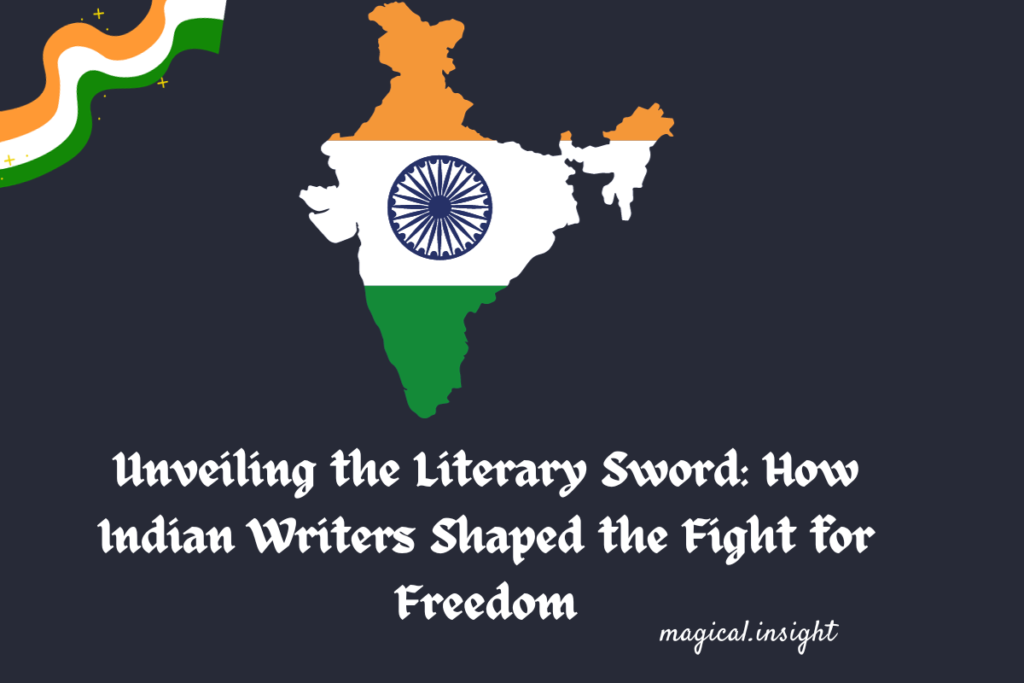
The battle for India’s freedom from British colonial authority was waged through more than simply political movements and combat grounds. It was a complex conflict that cut across many fields, including literature. The nationalism of the time was stoked by the writings of Indian authors who, empowered by the force of their words, expressed their ideas, feelings, and goals, inspiring future generations. These literary giants used their pen power as skillfully as any soldier would on the battlefield to become the voices of a nation’s desire for independence. Today let us honour those authors who contributed significantly to India’s struggle for independence by using language as a weapon.
Rabindranath Tagore: The Bard of Freedom
In addition to being a poet, the multitalented genius and Nobel laureate Rabindranath Tagore was also a philosopher, dramatist, and artist. During the independence fight, his writings—particularly his poetry and songs—served as a rallying cry for the populace. He demonstrated his talent for encapsulating the spirit of the fight in his poems through the creation of “Jana Gana Mana,” which went on to become the national anthem of India, and “Amar Shonar Bangla,” which went on to become the national song of Bangladesh.
Mahatma Gandhi: The Man of Letters and Action
Mahatma Gandhi, who is frequently referred to as the “Father of the Nation,” encouraged India to gain her freedom via both his words and his deeds. His essays for publications like “Young India” and “Harijan” outlined his beliefs in peaceful resistance and civil disobedience. His personal journey and hardships were made clear in his autobiography, “The Story of My Experiments with Truth,” which helped to humanise him and serve as an example to many people.
Subhash Chandra Bose: The Fiery Orator
Subhash Chandra Bose, who is more renowned for his work as a liberation fighter, was also a gifted author and speaker. His passionate and convincing words ignited the crowds and brought them together under the flag of freedom. His talks emphasised the need of a team effort in the fight for independence while simultaneously criticising British rule and urging Indians to come together.
Sarojini Naidu: The Nightingale of India
Poetry of Sarojini Naidu was a potent medium for conveying the hopes and ambitions of a country yearning for independence. Her stirring lines not only displayed her literary talent but also moved innumerable Indians. Naidu’s involvement in the Round Table Conferences and her connection to the Non-Cooperation Movement of Mahatma Gandhi provided evidence of how her words were easily translated into deeds.
Bankim Chandra Chattopadhyay: Weaving Patriotism through Novels
The literary works of Bankim Chandra Chattopadhyay, notably his novel “Anandamath,” had a significant impact on the development of nationalism. Readers’ imaginations were sparked by the novel’s depiction of a group of monks battling against injustice, instilling in them a sense of dignity and resistance.
Maulana Abul Kalam Azad: The Scholarly Freedom Fighter
The scholar and freedom fighter Maulana Azad had a strong passion for both education and India’s independence. In addition to criticising British policies, his works in “Al-Hilal” and “Al-Balagh” also helped Muslims and Hindus feel more at ease with one another. The focus Azad placed on education as an instrument of empowerment is still relevant today.
Bal Gangadhar Tilak: The Lighthouse of Resistance
The works of Bal Gangadhar Tilak, particularly those published in his Marathi daily “Kesari,” were crucial in igniting public opposition to British authority. His idea that “Swaraj is my birthright and I shall have it” became a catchphrase that resonated deeply in many people’s hearts. The independence movement was forever changed by Tilak’s forthright expression of his ideas and appeals for active opposition.
Bhagat Singh: The Voice of the Youth
Bhagat Singh was a skilled writer in addition to being mostly regarded as a revolutionary. His compelling articles and letters vividly captured his steadfast dedication to the cause of freedom and his idealistic view of a decent society. He served as a symbol of hope for the nation’s youth because to his eloquence and zeal.
Conclusion
It’s important to keep in mind that the struggle for India’s freedom was not limited to fighting on the battlefield. The literary representations of Indian independence were crucial in forming the public’s consciousness, sparking the spirit of patriotism, and giving those who yearned for freedom the bravery they needed. These writers sparked emotions, ignited aspirations, and gave the independence struggle an intellectual firepower through their poems, articles, and speeches.
Generations have been inspired by their writings, which serve as a reminder that words may be used as a powerful force for change in addition to being a method of expression. The literary works that defined Indian independence continue to serve as a tribute to the written word’s lasting power and the unbreakable resolve of a people determined to achieve freedom. Their legacy endures and serves as a constant reminder that genuine emancipation can only be attained by intellectual conflict and the perseverance of the human spirit, not only through physical conflict.