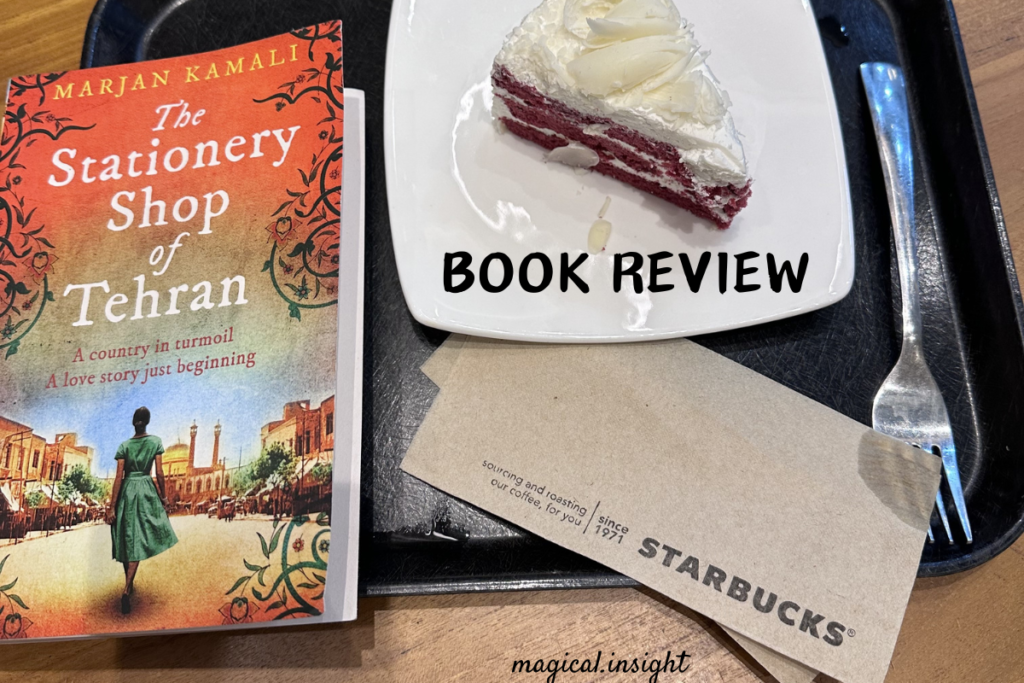
I stumbled upon “The Stationery Shop of Tehran” by Marjan Kamali which is really a touching and evocative book that masterfully combines the complexities of love, sorrow, history, and fate. The novel delivers a captivating tale that examines the lives of its multifaceted people and the everlasting power of love against the backdrop of Iran’s troubled past. I had an exciting and emotional trip with this book which has a lyrical tone, unanticipated turns, and a compelling storyline that reverberates long after the final page is turned.
The majority of the action takes place in 1953, just before Iran was about to experience a political revolution. It chronicles the relationship between Roya, a young woman who loves books and stationery, and Bahman, the young man who won her heart in the titular Tehran stationery store. Roya’s love of books and the vibrant culture of the city are quickly brought to life for readers owing to the author’s beautiful writing, which makes it simple to identify with Roya’s character and the hopes she harbours.
The narrative tone throughout the novel is elegantly poetic. The author’s writing is filled with vivid descriptions and sensory details that immerse readers in the sights, sounds, and emotions of Tehran. The writing has a way of making the ordinary seem extraordinary as if each page is an invitation to step into the past and experience the characters’ lives firsthand. This lyrical tone not only enhances the overall reading experience but also creates an emotional connection with the characters and their stories.
The storyline of “The Stationery Shop of Tehran” takes unexpected turns, keeping readers fascinated and keen to learn the destinies of the individuals. The novel’s most crucial twist happens early on, when a startling occurrence separates Roya and Bahman, causing their lives to diverge. The ramifications of this occurrence reverberate throughout the tale, and Kamali expertly creates a sense of suspense and desire that keeps the plot engaging.
The book’s examination of Iranian history and politics, notably the 1953 coup that deposed Prime Minister Mohammad Mossadegh, is one of its most interesting parts. Kamali smoothly incorporates these historical events into the story, giving readers a better grasp of the sociopolitical context of the time. The author illustrates the influence of these events on regular lives via the individuals’ own experiences, stressing the human aspect of history. This historical context adds depth and complexity to the work, making it more than just a love tale but also a picture of a pivotal period in Iranian history.
Roya is a bold and motivated young lady who challenges conventional standards. In a traditional culture, her pursuit of education, freedom, and love is laudable and inspirational. She is a character who grows and changes throughout the narrative, and readers will cheer for her every step of the way.
Bahman, on the other hand, is enigmatic and secretive, his personality moulded by personal views and political ambitions. His character’s complexity makes him both interesting and maddening since his decisions occasionally defy understanding. This complication deepens the plot and keeps readers guessing about his genuine motives.
The supporting characters in the novel are also well-developed, and their interactions with Roya and Bahman add to the narrative’s depth. The wide array of individuals gives depth to the plot, from Roya’s supporting sister Zari to the mysterious Walter, and their interactions provide insight into the cultural and socioeconomic dynamics of the time.
The dual temporal structure, which alternates between 1953 and now, provides a fascinating foundation for the story. An elderly Roya, now residing in the United States, reflects on her history and the long-lasting influence of her love for Bahman. This viewpoint is a bittersweet contrast to her youth’s exuberant love narrative. The author may also explore the themes of memory, nostalgia, and the passage of time thanks to the dual timeline.
“The Stationery Shop of Tehran” is a thought-provoking and emotionally moving tale about love, grief, sacrifice, and the passage of time. Marjan Kamali’s language is poetic and vivid, and it is a joy to read. The historical backdrop gives the plot depth and importance, and the characters are intriguing and realistic. The novel’s unpredictable storyline twists and turns keep readers on the edge of their seats, and its insightful investigation of fate and destiny makes it a truly memorable and thought-provoking read.
Ultimately, “The Stationery Shop of Tehran” by Marjan Kamali is a brilliantly written work that is both comforting and heartbreaking. It delves into the everlasting power of love as well as the effects of historical events on human lives. This is a work that will stay with us, reminding us that love can overcome time and adversity and that the past is never completely gone, but lives on in the memories and experiences of those who lived it.