
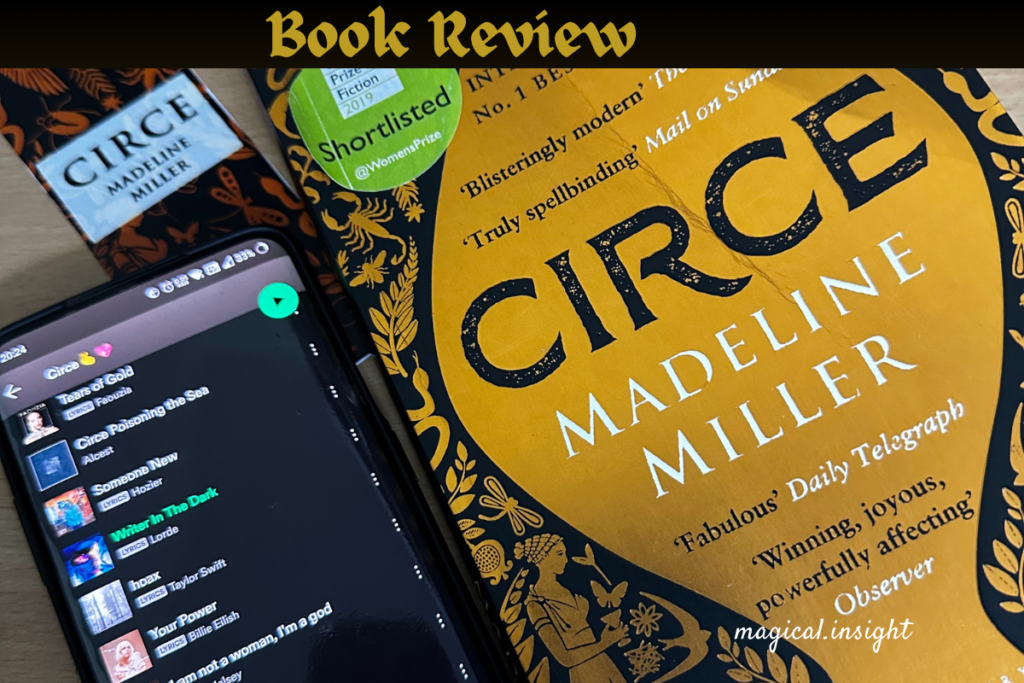
A work of literary brilliance, Madeline Miller’s “Circe” revives a frequently overlooked character in Greek mythology and transports readers on an enthralling journey into a world of gods, mortals, and the unbreakable spirit of a woman finding her voice in a world dominated by patriarchal deities. Miller’s writing is a symphony of language that evokes a wide range of feelings while vividly and authentically reconstructing the fabled world of ancient Greece.
The tone of “Circe” is an elegant expressive fusion of nostalgia, mysticism, and reflection that is appropriate to the story’s legendary roots. The reader is transported to the timeless landscapes of Aiaia, where waves smash against craggy coasts and the aroma of wild plants hangs in the air, by Miller’s words, which pulse with an alluring beat. Readers are compelled to enter Circe’s realm by the author’s command of tone, which creates an atmosphere of both wonder and dread.
The epitome of depth and intricacy is Circe. Miller recasts the mythical witch as a powerful woman who possesses both magical and emotional strength. In addition to being a story arc, Circe’s journey from a shy nymph to a fearsome enchantress is also a voyage of self-discovery. Circe’s changing emotions—vulnerability, yearning for acceptance, and ultimately realising her power—are expertly handled by Miller. In light of this complexity, readers may relate to her challenges and find inspiration in her as a protagonist. The solitude Circe experiences in Aiaia is compared to the isolation many women have experienced throughout history, and Circe’s eventual revolt against that isolation is compared to the human need for autonomy and self-expression. She is strong but empathetic, smart yet still learning, making her own way while still being impacted by the world around her, and she is powerful yet caring. These inconsistencies reveal the depth of her character.
The distinctive quality of “Circe” is its ability to eloquently weave together the inner conflicts of its protagonists with legendary grandeur. It’s amazing how well Miller can juggle different mythologies and people while maintaining a consistent plot. Circe’s story incorporates well-known characters like Daedalus, Athena, and Hermes, enhancing the narrative while providing new insights into their own mythological roles. Due to its discussion of feminism and female empowerment, the book appeals to contemporary readers. Circe’s rejection of patriarchal expectations and quest for autonomy serves as a rallying cry for women’s agency in a world that is frequently ruled by males.
Strong emotions are evoked by Circe’s connections, especially one with her son Telemachus. The hardships of motherhood are universal, and her undying love and sacrifices for her kid expose her frailties and maternal strength. The ethically nuanced characters in “Circe” muddy the distinction between good and evil. Readers are compelled to reconsider their own ideas of good and evil as a result of the moral ambiguity, which gives the narrative depth and realism. Beyond the distinction between gods and humans, the story explores the core of what it means to be human. Circe’s contacts with mortals and her interest in mortality provide light on the human condition.
In conclusion, Madeline Miller’s “Circe” is an exceptional work of literature that successfully fuses a contemporary sensibility with the everlasting appeal of mythology. Readers are invited into a world where gods and humans cohabit in exquisite harmony by Miller’s captivating narrative, which is every bit as alluring as the charms that Circe herself weaves. Every reader will be forever changed by Circe’s journey because she is the victorious personification of self-empowerment and discovery. For anybody looking for an immersive, thought-provoking, and absolutely engrossing reading experience, “Circe” is a must-read tribute to the transforming power of narrative.